

Labour Law Compliance service is no longer a back-office task; it has become a core business responsibility for every employer operating in India. Whether you run a startup, a trading firm, a factory, a service company, or a growing MSME, labour compliance directly affects your payroll accuracy, documentation quality, employee welfare standards, business registrations, and overall audit readiness.
A well-structured Labour Law Compliance service helps employers stay aligned with wage rules, social security requirements, statutory registers, and workplace obligations under Indian law. It also reduces the risk of financial penalties, employee disputes, delayed inspections, and compliance notices from regulators.
If you are building a compliant and future-ready business, this guide will give you a clear, practical, and employer-friendly roadmap to follow. It explains what to check, what to maintain, what to monitor, and when to seek expert support so that your business remains fully compliant. If you need professional assistance with any of these areas, you can explore LegalBabu to get more help.
What Is Labour Law Compliance in India?
Labour law compliance in India refers to the systematic process of following all legal requirements that govern wages, employee benefits, working conditions, workplace safety, social security, and mandatory employer records. In practical terms, a Labour Law Compliance service helps employers track and fulfil their obligations under wage laws, provident fund rules, ESI provisions, establishment regulations, employee documentation standards, and periodic regulatory filings. You can review the official consolidation of India’s labour law framework on the labour codes page of the Ministry of Labour and Employment.
For employers, labour compliance is not limited to one law or one filing; it is a continuous and interconnected system of responsibilities. It includes checking whether your establishment is properly registered, verifying that wages are structured correctly, confirming that eligible employees are covered under PF and ESI schemes, ensuring that attendance and leave records are maintained accurately, and validating that contractor and vendor arrangements are legally safe.
Why Is Labour Law Compliance Important for Employers?
A strong Labour Law Compliance service protects both the business and the employee at every stage of the employment relationship.
When compliance is handled properly, employers are far better prepared for surprise inspections, payroll reviews, employee disputes, vendor audits, and due diligence exercises during funding or acquisition. On the other hand, when compliance is ignored, even small errors can quickly turn into backdated liabilities, interest charges, financial penalties, or serious operational delays.
Here is why employers should treat Labour Law Compliance service as a top business priority:
-
Regulatory protection: It significantly reduces the risk of government notices and financial penalties.
-
Employee trust: It improves trust and confidence among employees, investors, and business stakeholders.
-
Clean payroll: It supports accurate payroll processing and reliable statutory record-keeping.
-
Scalable growth: It helps businesses scale confidently with lower compliance-related risks.
-
Audit readiness: It creates better preparedness for statutory audits, investor funding, and legal due diligence.
The official EPFO employer portal itself highlights that online compliance facilities are available for establishment registration, filing of monthly returns, and payment of contributions by all covered employers, which shows how important digital labour compliance has become. You can verify these facilities directly on the EPFO employer services portal.
Labour Law Compliance Service: Core Checklist for Indian Employers
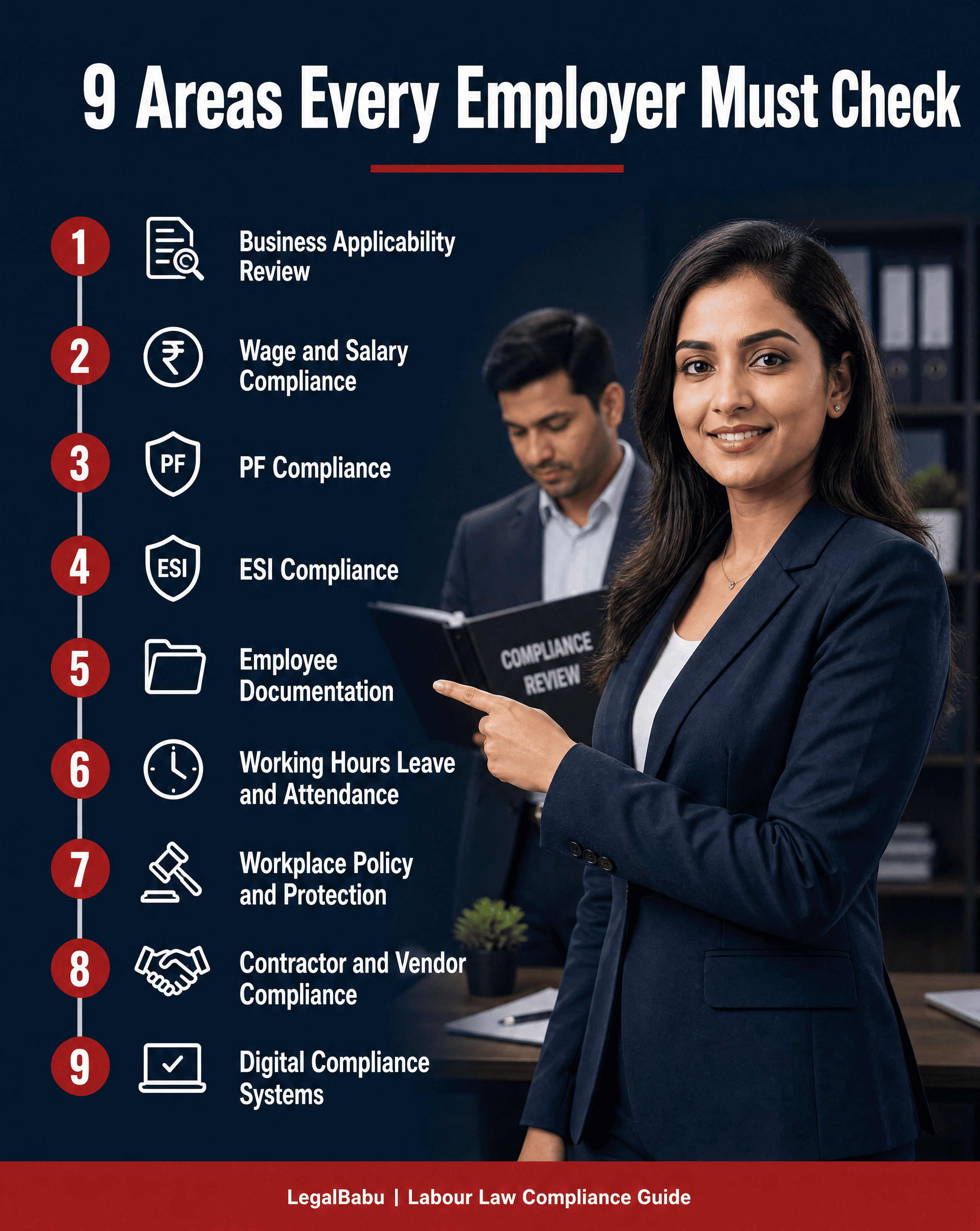
1. Review your business applicability before anything else
The very first step in any reliable Labour Law Compliance service is to review which labour laws actually apply to your establishment. Applicability depends on the type of business you run, the total number of employees on your rolls, the wage levels being paid, and the specific state in which your establishment is operating.
Your applicability review should carefully cover the following areas:
-
The nature and category of your establishment
-
The total number of employees currently on the rolls
-
The extent of contract labour or outsourced staff you use
-
State-specific Shops and Establishments Act requirements
-
Whether factory, office, shop, warehouse, or service-based rules apply
This is exactly where many businesses make their first mistake. They often assume that compliance obligations begin only after they become “large enough,” but in reality, several statutory obligations begin much earlier in the business lifecycle.
2. Check wage and salary compliance carefully
Wage compliance sits at the very heart of a reliable Labour Law Compliance service in India. Employers must make sure that all salary structures are transparent, lawful, and properly documented in line with applicable laws.
Your wage compliance checklist should include the following important items:
-
Timely payment of wages every month without delay
-
A correctly structured salary break-up as per applicable rules
-
Full compliance with the applicable minimum wages notified by the state
-
Proper treatment of overtime hours, where applicable
-
Accurate issuance of wage slips and maintenance of payroll records
-
Correct treatment of statutory deductions and permissible allowances
A business may believe it is compliant simply because salaries are being credited on time, but that alone is not enough. The wage structure itself, the actual timing of payment, and the supporting statutory records are all equally important for full compliance.
3. Ensure PF compliance wherever applicable
The Employees’ Provident Funds and Miscellaneous Provisions Act, 1952, applies to specified factories and notified establishments engaging 20 or more employees. For covered employers, compliance includes registration, contribution management, filing of periodic returns, and careful record maintenance, as clearly explained on the official EPFO employer information page.
A strong Labour Law Compliance service should carefully review each of the following PF-related areas:
-
Whether PF registration applies to your establishment
-
Proper mapping of eligible employees to PF coverage
-
A timely and error-free monthly contribution workflow
-
Correct alignment of UAN records with payroll data
-
Supporting wage records and attendance registers
-
Any hidden PF exposure arising from contractors or vendors
If your business is expanding rapidly, this review should be completed at the earliest before compliance liabilities silently accumulate over time.

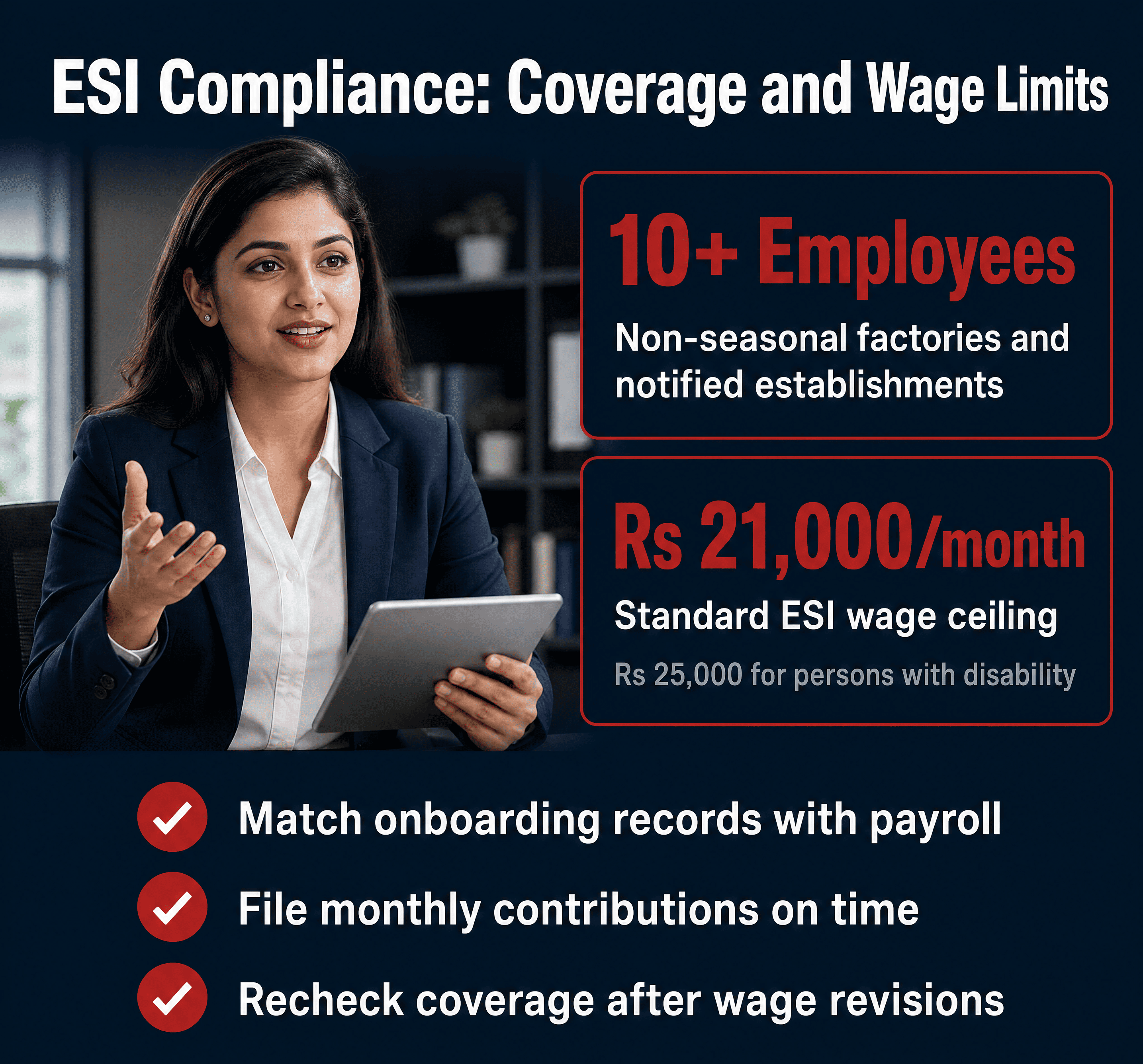
4. Ensure ESI compliance wherever applicable
The ESI Act applies to all non-seasonal factories employing 10 or more persons and, under various notifications, also covers shops, hotels, restaurants, road motor transport undertakings, newspaper establishments, private medical and educational institutions, and several other notified categories. The current wage limit for coverage under the Act is ₹21,000 per month, with a higher limit of ₹25,000 per month for persons with disabilities, as officially notified on the ESIC coverage page.
This means your Labour Law Compliance service should carefully assess each of the following ESI-related areas:
-
Whether your establishment currently falls under ESI coverage
-
Which of your employees fall within the notified wage threshold
-
Whether your employee onboarding records fully match payroll records
-
Whether monthly contributions and returns are being deposited on time
-
Whether ESI coverage continues even after temporary threshold changes
If you need dedicated support in this specific area, you can explore LegalBabu’s ESIC registration and compliance service for structured assistance from experienced professionals.
5. Maintain complete employee documentation and appointment records
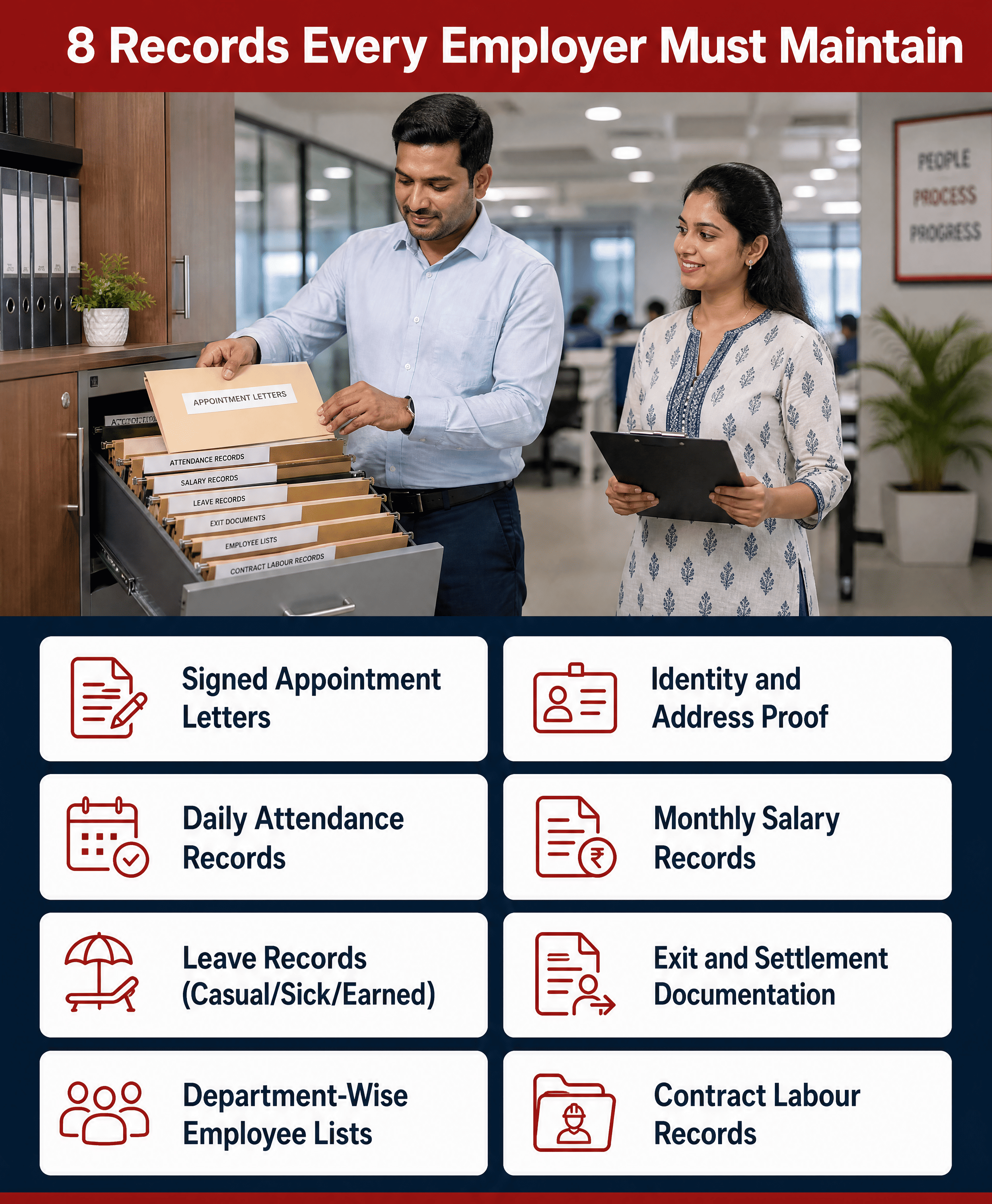
A professional Labour Law Compliance service is never complete without strict documentation discipline across the organisation. Every employer must maintain clear, updated, and easily retrievable employee records at all times.
Your documentation checklist should include the following important items:
-
Signed appointment letters for every employee
-
Verified identity and address proof records
-
Daily attendance records are maintained in a proper format
-
Monthly salary records aligned with payroll
-
Leave records covering casual, sick, and earned leave
-
Exit records and final settlement documentation
-
Department-wise employee master lists
-
Separate records for all contract labour, where relevant
Well-maintained records make regulatory inspections much easier and significantly reduce the chances of employee disputes escalating. Poor documentation, on the other hand, often creates confusion and legal exposure even when the employer has genuinely acted correctly.
6. Monitor working hours, leave, and attendance closely
Working-hour compliance is one of the most commonly overlooked areas until an inspection or a formal dispute suddenly arises. Employers should build clear internal systems for attendance, weekly offs, overtime, shift timings, and statutory leave entitlements.
Your Labour Law Compliance service should carefully review each of the following:
-
The attendance capture method being followed
-
The approval workflow and recording of overtime hours
-
Weekly offs and public holiday compliance
-
The structure and communication of your leave policy
-
Complete shift records wherever shift work applies
-
Accurate mapping of payroll data to attendance data
This is especially critical for multi-location businesses, retail chains, factories, warehouses, and any business that operates using shift-based teams and rotating rosters.
7. Strengthen workplace policy and employee protection systems
A responsible Labour Law Compliance service is not just about deposits and forms; it should also cover workplace conduct, employee welfare, and internal governance systems. Employers should build and maintain formal frameworks in each of these areas.
Every compliant establishment should maintain the following:
-
Clearly written and communicated workplace policies
-
A structured anti-harassment and grievance redressal system
-
Basic safety and welfare measures at all working locations
-
First-aid arrangements and essential employee welfare support
-
Transparent communication of employment terms and conditions
-
A defined escalation process for internal workplace concerns
A compliant workplace is always easier to manage, easier to scale, and significantly less vulnerable to disputes, litigation, or reputational damage.
8. Audit contractor and vendor compliance regularly
If your business engages contractors, third-party staff, or outsourced manpower agencies, your Labour Law Compliance service must extend far beyond the direct payroll of on-roll employees.
This important area should carefully cover the following elements:
-
Properly executed contractor agreements
-
Complete worker deployment records at each site
-
Continuous monitoring of wage payments to contract workers
-
Clear PF and ESI responsibility mapping between the parties
-
A thorough principal employer exposure review
-
Verification of every vendor’s statutory documents
This is one of the most sensitive and misunderstood areas within labour compliance today. Many businesses wrongly assume that the contractor alone is responsible, but under Indian labour law, the principal employer can still face significant regulatory exposure if the structure is weak or poorly documented.
9. Use digital compliance systems wherever possible
The best Labour Law Compliance service is always structured, well-documented, and fully audit-ready at any point in time. Manual systems may work at a small scale, but they quickly become risky when headcount, locations, or vendor complexity begins to grow.
A stronger digital approach should include the following elements:
-
Digitised payroll processing with statutory support
-
A centralised employee master record system
-
Statutory registers are maintained in easily retrievable formats
-
A single, secure central document storage location
-
Automated compliance filing trackers and reminders
-
Regular compliance calendar reviews by management
The EPFO employer platform already emphasises online processes for registration, returns, and payments, and employers should build internal compliance systems that fully support this digital readiness, as clearly outlined on the EPFO employer portal.
The Shram Suvidha Portal is also part of the broader digital compliance workflow used across India for online labour law registration, licensing, and unified filings by covered establishments, and you can access it directly at the Shram Suvidha Portal.
Key Labour Law Compliance Areas at a Glance
|
Compliance area |
What employers should check |
Why it matters |
|
Establishment applicability |
Business type, employee count, state rules |
Helps avoid missing statutory registrations |
|
Wage compliance |
Minimum wages, salary structure, wage records |
Prevents wage disputes and financial penalties |
|
PF compliance |
Registration, contributions, returns, employee mapping |
Ensures full social security compliance |
|
ESI compliance |
Coverage, wage ceiling, contributions, employee records |
Protects employee health and welfare rights |
|
Documentation |
Appointment letters, attendance, leave, payroll |
Ensures audit and dispute readiness |
|
Working hours |
Overtime, shifts, weekly offs, leave records |
Maintains smooth operational compliance |
|
Workplace policy |
Employee protection systems, grievance process |
Creates a safer and stronger work environment |
|
Contractor compliance |
Vendor records, worker coverage, principal employer review |
Reduces hidden third-party legal risk |
|
Digital records |
Compliance calendar, filings, data retrieval |
Enables faster audits and better governance |
Common Labour Law Compliance Mistakes Employers Make
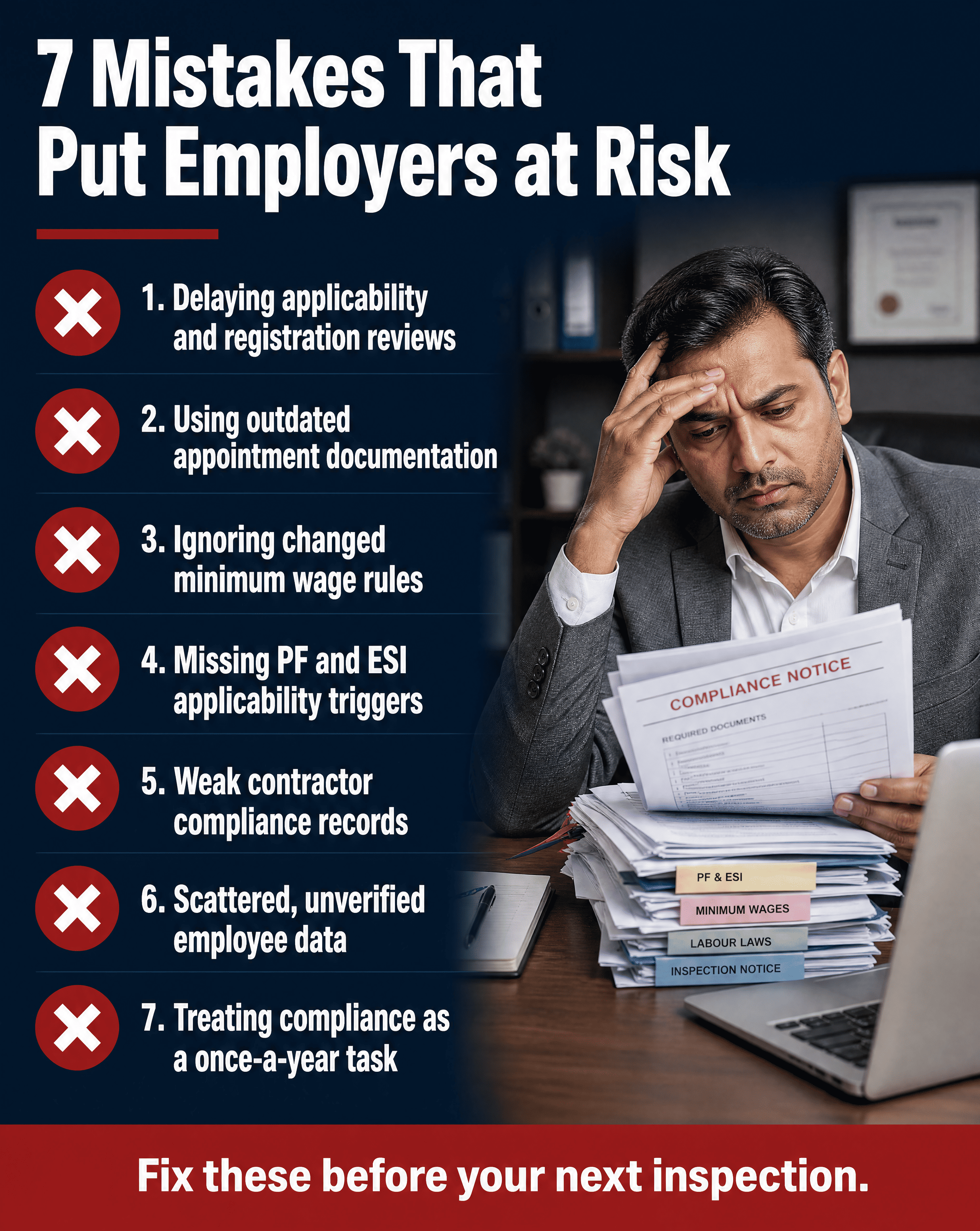
Most compliance failures happen because employers stay reactive, not because they intentionally break the law. Understanding these common mistakes is the first step toward building a stronger Labour Law Compliance service internally.
The most common compliance errors seen across Indian businesses include the following:
-
Delaying periodic applicability and registration reviews
-
Using incomplete or outdated appointment documentation
-
Following salary structures that no longer match current wage rules
-
Missing important PF or ESI applicability triggers on time
-
Ignoring proper contractor compliance documents and records
-
Keeping scattered, inconsistent, or unverified employee records
-
Treating labour compliance as a once-a-year exercise
A reliable Labour Law Compliance service solves this problem by turning compliance into a repeatable and predictable system, instead of leaving it to last-minute corrections during an inspection or notice.
How LegalBabu Can Help With Labour Law Compliance Service
LegalBabu’s compliance approach is designed to be practical, preventive, and business-friendly for Indian employers. Instead of waiting for regulatory notices to arrive, businesses should build a system that identifies compliance gaps early and fixes them well before they turn into major liabilities.
LegalBabu supports businesses through the following areas of assistance:
-
End-to-end labour compliance applicability review
-
Documentation review and compliance checklist assessment
-
Structured PF and ESI compliance support
-
Internal compliance gap analysis and remediation
-
Contractor and vendor compliance assessment
-
Statutory filing and process support
-
Ongoing advisory support for growing businesses
Read Also: Businesses handling broader registrations and tax formalities can also review LegalBabu’s dedicated GST registration support service, and early-stage founders can benefit from LegalBabu’s specialised startup services for a strong compliance foundation.
Want to Learn More? You can visit the LegalBabu learning centre for many more practical guides on business setup, statutory compliance, legal filings, and long-term growth support.
Conclusion
A good Labour Law Compliance service does far more than help you tick regulatory boxes on a checklist. It protects your business structure, strengthens your HR systems, and helps your company grow with confidence in a highly regulated environment. In India, labour compliance is a continuous responsibility that covers business registrations, wage payments, social security, employee records, contractor management, and overall workplace governance.
If your business is currently hiring new employees, expanding into new locations, outsourcing operations, or opening new branches, right now is the ideal time to review your entire compliance framework. A proactive Labour Law Compliance service review today is always significantly better than dealing with a compliance notice tomorrow.
FAQS
FAQs About Labour Law Compliance Service
-
What is a Labour Law Compliance service?
A Labour Law Compliance service is a professional advisory offering that helps employers manage their legal obligations related to wages, employee records, PF, ESI, workplace policies, statutory filings, and overall labour audit readiness in India.
- Who needs a Labour Law Compliance service in India?
- Why is a Labour Law Compliance service important for employers?
- Does a small business also need a Labour Law Compliance service?
- What does a labour law compliance checklist usually cover?
- When does PF compliance become important for employers?
- When does ESI apply to employers in India?
- Can contractors create labour compliance risk for the principal employer?
- What records should employers maintain for labour compliance?
- Is the Labour Law Compliance service a one-time task?
- Can LegalBabu help with ESIC and related compliance work?
- What is the best way to start labour compliance for a new business?


